Posts

Pembrokeshire Part 2 (The Preselis)
Image
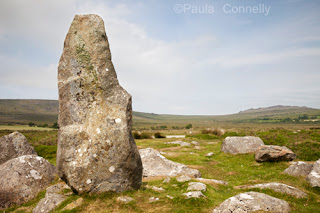
As well as a truly spectacular coastline, Pembrokeshire also boasts an abundance of prehistoric sites including the hillside from which the bluestones of Stonehenge were hewn - the Preselis. Quite how the inner ring of Stonehenge's bluestones were transported the 180 miles from the summit of the Preseli Hills to Salisbury Plain in Wiltshire remains a mystery.   There are 80 stones in total, each weighing approximately five tons, giving rise to debate as to whether people or glacial action moved them.     I tend to favour the theory that their movement was the deliberate work of a group of people in view of the significant number of early prehistoric sites that have been discovered in the area surrounding Carn Menyn, the main source of bluestones. Our holiday cottage had an uninterrupted view across to the distant Preseli Hills and a walk among the bluestones was at the top of my holiday itinerary.   Normally I would look at the weather forecast for the week and p...
Pembrokeshire Part 1 (The Coastal Path)

Image
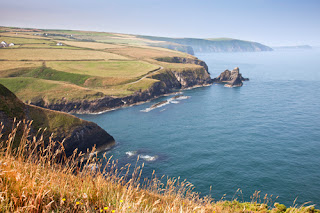
I'm not normally blessed with good weather when I go on holiday.   The usual pattern seems to be that I set off, full of expectation for beautiful scenery and blue skies, only to spend the majority of the week under a blanket of grey with hardly a flicker of sunlight.   It's not that bad weather bothers me too much.   It is, after all, the only part of a holiday that can't be arranged.   It becomes significant though if, like me, you're hoping to get some good photos. This year turned out to be the exception as we set off for our holiday in Pembrokeshire (South West Wales)   in the middle of   a heat wave.   In fact (and I hate to say this) at times it was almost too hot and sunny. The county of Pembrokeshire is home to the only coastal National Park in the UK.   Some 186 miles of dramatic coastal scenery have been incorporated into the Pembrokeshire Coastal Path, a National Trail which can be enjoyed in short sections or as a complete lo...

A new pair of boots

Image
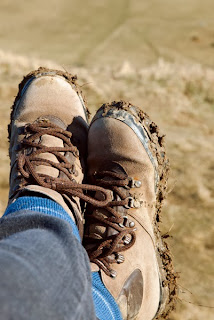
One of the results of my renewed interest in long walks and hill climbs has been that I've needed to invest in some new gear.   When I started out earlier this year all I had was a very old pair of walking boots and a "waterproof/breathable" coat which I quickly discovered was neither waterproof nor particularly breathable.   My earlier walks were undertaken in jeans and cotton t-shirts, which any serious walker will tell you are highly inappropriate items of clothing.   So, as the year has progressed and my walks have increased, I've had to invest in several items of kit.   First on my list was a new pair of boots.   I'd had my old boots for nearly 25 years and they had been wonderful.   I worked out that I must have walked hundreds of miles in them but even so there was very little sign of wear to the soles and they still had their original laces.   It was the insides that were wearing out, to the extent that they had begun to rub and after one of...

Steam Trains, Stepping Stones and Honey

Image
I really love the North York Moors.   And I love steam trains too.   So it's no surprise that my favourite walks often combine the two with a route planned to take in a section of the NorthYork Moors Railway . From the pretty town of Pickering the North York Moors Railway winds its way through some of the loveliest scenery in Yorkshire, visiting the popular villages of Goathland and Grosmont before joining the Esk Valley Railway which continues to the seaside town of Whitby. Until the early 19th century the port of Whitby was only really accessible by sea.   In fact, there had been no proper road links to the town until the opening of the turnpike in 1759 and even after this date journeys across the high moorland were perilous.   In 1832, after consultation with the "Father of Railways", George Stephenson,   it was decided to build a railway to Whitby from Pickering.   In 1833 the Whitby and Pickering Railway Bill received royal assent and the fir...

Rosedale, North York Moors

Image
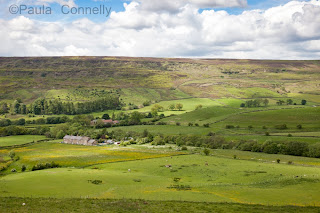
When choosing a route for a walk I usually take into account potential photographic opportunities and, more often than not, likely looking places for refreshment breaks.   My "refreshment break" of choice would usually   be a local ale and a tasty pub meal, but on this occasion I wanted to sample the treats on offer in the garden of a moorland farmhouse in the picturesque valley of Rosedale.   The route I planned was a nine mile circuit, starting and ending at the village of Rosedale Abbey and following the line of the old Rosedale Railway before dropping down to the farmhouse tea garden and then continuing back along the valley bottom. The Rosedale valley is green and fertile, nestling between the higher moorland of Blakey Ridge and Spaunton Moor.   Today it is home to a few quiet farms and many of the houses along the valley are now second homes and holiday cottages.   It's a tranquil place, but a century ago things were very different indeed.   ...

Newtondale

Image
My next walking excursion after my ascent of Roseberry Topping was in April, when we visited Hadrian's Wall, but as I've blogged about this already I'm now jumping forward to June 2013 and a delightful walk on the North York Moors. We started this walk from the Hole of Horcum (the 'r' in Horcum is silent by the way), which is part of Newtondale in the North York Moors National Park.  Leaving from the roadside car park on the main road midway between Pickering and Whitby (the starting point for several moorland walks of varying distances), we completed an eight mile circular route, part of which overlooked a particularly spectacular section of the North York Moors Railway.  My intention was for us to have a picnic lunch at Skelton's Tower, the ruins of a two-storey tower which was built in 1850 as a shooting lodge by a former vicar of Levisham, the Reverend Robert Skelton. Some say that he wrote his sermons in the lodge but it is also rumoured that he escaped h...

Roseberry Topping

Image
My rediscovery of the joy of country walking began in earnest with a visit to Roseberry Topping , in the Cleveland Hills, on the very edge of the North York Moors National Park.  At 1,049 feet (320m) it isn't a mountain (a mountain in the UK is over 2,000 feet), but nevertheless it presented something of a challenge to someone like me who has always found walking up an incline something of a struggle.  I therefore decided to test myself.  If I could make it to the top and survive then perhaps it was time to think about tackling bigger hills and, eventually, even a mountain. Spring seemed to start very late this year and the cold weather lasted well into May.  The day we drove out to the village of Great Ayton to start the short walk up Roseberry Topping saw glorious blue skies and sunshine, giving a false sense that Spring may finally have arrived.  We weren't the only ones lured out by the sunshine.  A steady...

Rural ruins

Image
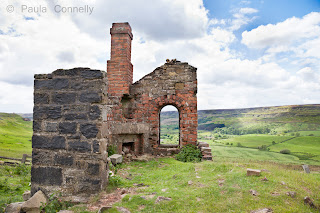
As a photographer I'm particularly drawn to derelict old buildings in picturesque   countryside settings.   There's something about the contrast between the decaying state of the abandoned manmade structure and the   natural beauty of its surroundings.   Sometimes the contrast is stark but sometimes the building actually adds a certain element of interest to the scene, providing   a focal point to an image.   Very often I find that the camera doesn't do justice to what my eyes tell me is a beautiful scene.   The inclusion of an old ruin can certainly add an element of interest. The image below is Rosedale in the North York Moors National Park and the ruin was once a cottage belonging to the nearby Rosedale East Mines.   Here, from 1864 to 1926, ironstone was mined from the daleside by the Rosedale Mining Company.       Today the   area is tranquil but once the whole valley was scarred with mining activity and a rai...

An exploration of British wild flowers

Image
A couple of months ago I bought myself a new macro lens for my digital SLR camera.   For anyone who doesn't know what a macro lens is, basically it allows you to focus on objects at very close range and the resulting images are reproduced at a ratio of 1:1.     With my lens, for example, I can focus on a small postage stamp until it fills the frame and this will be recorded at actual size on the camera's sensor. I originally bought the lens for food photography, but a very pleasing by-product of this has been my discovery of flowers, particularly wild flowers.   My new lens is perfect for getting in as close as possible to a flower and really showing off its beauty.    And in doing so I've then gone on to identify each specimen, which isn't always easy.   There are several sites on the internet which allow you to key in various attributes of the flower, such as petal shape and colour, and by a process of elimination   so far I've identified...

Badgers

Image
Until last week I had never seen a badger.  Well, actually, that's not strictly true.  I'd seen them on television nature programmes and, sadly, I've seen several dead ones at the side of the road.  I even got out of the car once to take a close look at one which had been recently mown down and, for a brief moment, I considered taking it to a taxidermist.  In the end though I drove on and left it for someone else who fancied the idea of having a stuffed badger in their living room or, more likely, as a substantial meal for the crows. Then last week my badger drought ended.  Suddenly I found myself keeping nightly company with not one but three of the adorable, humbug faced little creatures.  The place was Wales.  North Pembrokeshire to be exact, where myself and my husband had rented a small cottage on an isolated farm.  When I had booked the cottage several months previously, I vaguely recall there being mention on the website th...

A visit to Hadrian's Wall

Image
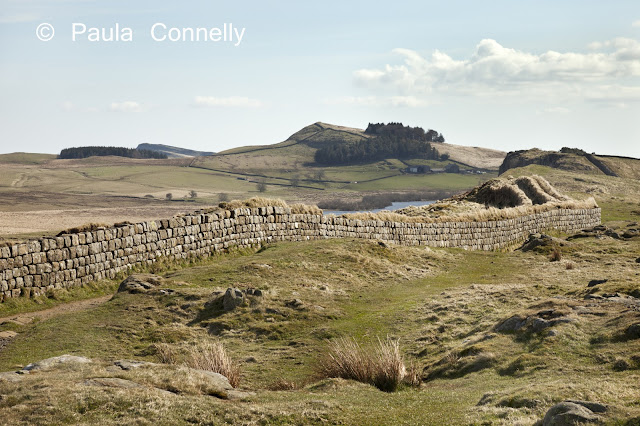
I just love visiting Hadrian's Wall.  I've lost count of how many times I've been there now, but I never tire of the place.  Quite apart from the fact that it's teeming with Roman history and archaeology, it just feels so wild and wonderful. My last visit was back in April (2013) when, for once, the weather was very kind to us.  Well, let's say it was kinder than usual in that we were up there for two days and the first day was fairly sunny.  It only rained a bit on the second day (just for the duration of our four hour walk).  Even when it rains though, it's still a truly magical place and there's something strangely satisfying about walking into the wind with your hood up and your head down.  It makes the tea room at the end all the more welcome. On each of the two days this visit we (that is myself and my husband) walked circular routes of around 8 miles each, setting off on each walk from the visitor centre at the intriguingly named Once Brew...